Same discipline, different envelope
An AI training hall, a street-side edge node and a bank’s mission-critical facility are the same engineering problem at different scales — and they are certified against the same Tier definitions.
Four products, one method
The engineering discipline is identical. What changes is density, redundancy, footprint and how fast capacity has to arrive.
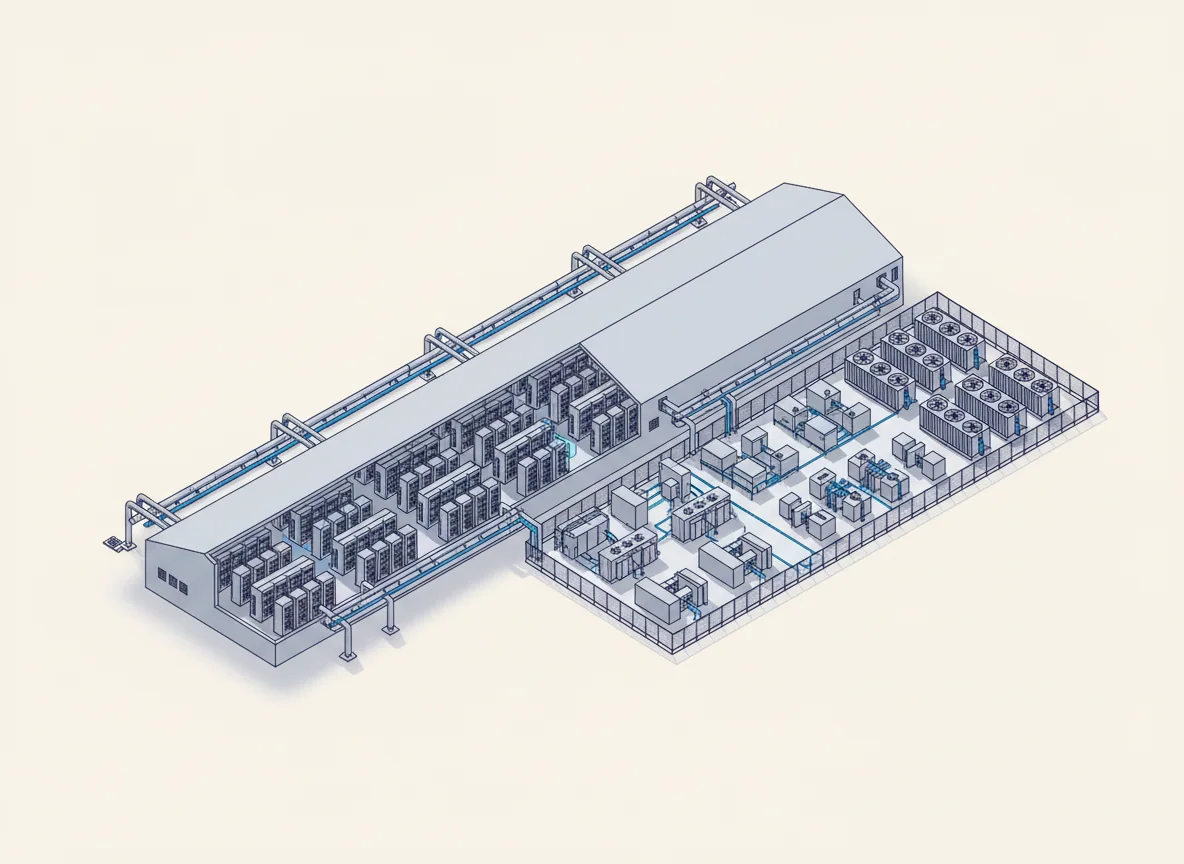
AI Data Center
Purpose-built for dense accelerated compute: liquid cooling to the chip, 2N power to the row and a non-blocking fabric between every node.
Choose the Tier, not the marketing
Tier is a topology statement, not a quality badge. Most AI builds are correctly Tier III; paying for Tier IV only makes sense when a single fault must never reach the load.
| Criterion | Tier I | Tier II | Tier III | Tier IV |
|---|---|---|---|---|
| Availability | 99.671% | 99.741% | 99.982% | 99.995% |
| Annual downtime | 28.8 h / year | 22.0 h / year | 1.6 h / year | 26 min / year |
| Redundancy | N | N+1 | N+1 | 2N / 2N+1 |
| Distribution paths | Single path | Single path, redundant components | Multiple paths, one active | Multiple active independent paths |
| Maintenance | Full shutdown required | Shutdown for distribution work | Concurrently maintainable | Concurrently maintainable |
| Fault tolerance | None | Partial | Single fault tolerant on maintenance | Fully fault tolerant, compartmentalised |
| Relative CAPEX | 1.0× | 1.2× | 1.5× | 2.0× |
| Recommended for | Test, development, non-critical workloads | SME, internal IT, secondary sites | Colocation, cloud, enterprise, most AI builds | Banking, exchanges, government, sovereign AI |
Tell us what you are building
Send the site status, the grid offer and the target load. You get a concept, a power and cooling strategy and an indicative CAPEX back.